


Belitronic
Electric Mackerel and Pogie Reels
ShoreTech is proud to be the ONLY dealer in the United States for Belitronic. A Swedish company that specializes in electric mackerel and pogie reels. With 6 different "jigging" programs, these reels enable you to bring in large amounts of catch, at the push of a button!! Theres a reason commercial fishermen choose this brand. Learn more by scrolling down, visiting their website below or by giving us a call at (351)217-9400!!

Their Story
Belitronic introduced in 1973 its first electronic fishing machine. Initially, all machines were exported to northern Norway for cod and octopus fishing, but have since spread in tens of thousands of machines to more than 90 countries worldwide. The Nordic region and especially Norway is still a large market. Australia, New Zealand and North America started later and the most recent major markets are Alaska and Canada.
The first model produced was BJ5 (1973-1985). It was fist built up by a aluminum wheelhouse and separate electronic house. Later the model was upgraded with an aluminum motor house, as water protection.
The electronic unit was made up of 3 electronic boards, the keyboard, mainboard and powerboard. BJ5 had 3 fishing program's, the Normal fishing, Step jig fishing, and Catch down fishing. Later it was upgraded with Bottom fishing. Selected by a front knob.
The speed of the motor was eighter stopped, or full speed. Line torque was controlled by two analogue knobs on the front. Another 3 knobs were used to select the "Fishing depth" and 2 more for "Jig length". (In early years the knobs was thumb wheel switches ). Four buttons in the front were used. Stop and Up for manual control, Auto for start using built in fishing program and Zero for reset the Line out counter. The Line out counter had three 7-segment LED display 10mm high that could show -199 to 199 and a flashing F for "Fish". BJ5 was sold in 4 variants. For 12 or 24 volt power supply voltage, and with line outlet on the right side of the machine (as picture) or left side. This also defined what side (opposite to line outlet) the mounting pole was at. The electronic unit's front was made in plexi glass and painted black. Later 24 volt machines had blue paint, and 12 volt green, as in picture.
The other model was JR or Juksa Robot (1984-1986). It was the first model equipped with a microcontroller compared to previous TTL gate logic. The display was changed from LED to an LED backlit LCD that could show not only the line counter up to 999 but also some of the values that was fixed in BJ5. The motor speed became adjustable. Still, separate machines were ordered for the machine's bracket on the right and left sides and for 12 and 24 volt supply voltage, respectively. The holder for the outrigger (rod) was in an adjustable bracket on the top that could be adjusted to control the line to the center of the wheel. The wheel was opened with cover plates that were mounted as needed if the line was to be taken out on the right or left side. The electronics sat in a separate aluminum box with a front panel on the slightly sloping front edge of the machine house. The entire box was sent for service as a unit. The three knobs for Nappet's sensitivity (CATCH) and the wheel's traction force when motor was working (DRAG), or when line going down (BRAKE) just like the knob for Fishing depth. The Jig Length dial, on the other hand, also had to act as a selector of parameters and value in the menu system together with a button (P) for Programming. Previous known for selecting fishing program was replaced by three buttons. The four buttons for running the machine Auto, Stop, Up and reset of the Line Counter were retained. All buttons are built into the front overlay.
The third model Unique (1986-1992), also called JR2 was a further development of the JR and above all got a stronger engine. The box was straight. The cast front box was replaced with a front plate where the two electronic cards are mounted against the back. The entire front plate was sent in in case of service. The wheel's open construction with wings to guide the line was replaced with a stainless steel housing with an opening that could be rotated around the wheel 360 degrees to the desired location. The LCD display with previously fixed texts was replaced with an EL-backlit standard Dot Matrix Display 2x16 characters 10mm high. The three knobs for the Catch, Drag and Brake and reset of the Line Counter were maintained. On the other hand, the button (P) for programming and the knobs for Fishing depth and Jig length were replaced with a printed tableau (as a map) on the front with all values that could be changed and with 4 arrows for navigation between these and One knob to change the value. The display showed value in accordance with the tableau. Also Fishing depth and Jig length were in the Tableau . Like previous models, the model must be ordered for 12 or 24 volts power supply. The bracket for the outrigger on top was retained.
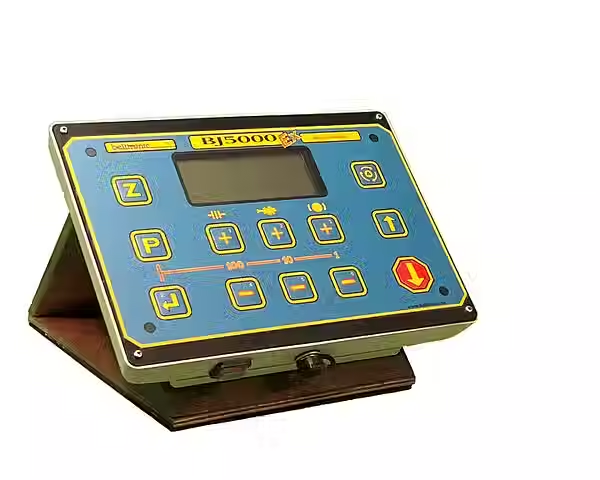
The fourth model BJ5000 (1994-1995). The first model where the base of the machine is a machined plate, instead of a cast box, where everything is mounted and then covered by a cast box in pvc plastic. The wheel is molded in fiberglass-reinforced plastic. The knobs Catch, Drag and Break are replaced with three groups of each +/- buttons. These three groups are also used in the menus in the display and, among other things, they affect values with +/- 100.10 and singular. The programming key (P) was given a complimentary Enter key (E) to jump from menus. A novelty was that the machine can run at both 12 and 24 volts. At start-up, the machine measures the supply voltage and adapts accordingly. Machine bracket only on the right side. The wheel is open and a more advanced brake ensures that the line does not get tangled if a sudden stop on the line occurs. The display is of the same type as before but with a LED backlight. The built-in buttons in the front overlay are removed and replaced by real push buttons with a touch feel and backlight. The top holder for the outrigger is replaced with two brackets that are mounted on the upper edge of the machine on each side. The brackets cannot be rotated.
The fifth model BJ5000 (1995-2015). Generation 2 of BJ5000 where the model name is retained. A stronger and better frame plate with more attachments to the box, which is now fiberglass-reinforced. The plastic wheel is replaced with Aluminum, of which the first wheels were turned, but then were die-cast in two halves. Buttons and display, menu system and machine mount are identical to generation 1. The Catch indicator got four LEDs in the front corners. Sensors for wheel pulses are replaced with a better type. The electronic devices between generation 1 and 2 cannot be shifted between. Outrigger bracket as generation 1.
The sixth model BJ5000 Ex (from 2013 and still in production) . The model looks very similar to the BJ5000 generation 2 but has only the box as a common part with a minor adjustment that the supply cable is now moved under the machine. This prevents water from running down the cable and into the machine. The motor becomes brushless, and both stronger at the same time as it consumes less power. It is also faster and can work in any direction. The machine got loose brackets that can be attached to any side of the machine or not be used at all if direct bolting to a wall is desired. Ex can work with varied supply voltage during operation between 12-24 volts. The frame plate is reinforced and has water-repellent edges. The display is changed to 192x64 pixels by graphic LCD. Communication is introduced via RS-482 so that the machines can be remotely controlled and reprogrammed.
Product Line - Up

BJ 5000 Ex
Remote Control RC12
